














Anna Grzymala-Busse
Media Experience
Radio France
The Guardian
Irish Times
New Republic
CBS Radio
Available for Interviews In
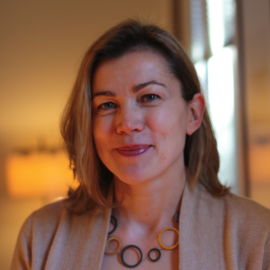
Anna Grzymala-Busse is the Michelle and Kevin Douglas Professor of International Studies in the Department of Political Science, the Director of the Europe Center, and Senior Fellow at the Freeman Spogli Institute. Her research focuses on the historical development of the state and its transformation, political parties, religion and politics, and post-communist politics. Other areas of interest include populism, informal institutions, and causal mechanisms.
She is the author of four books: Redeeming the Communist Past: The Regeneration of Communist Successor Parties; Rebuilding Leviathan: Party Competition and State Development in Post-Communist Europe; Nations Under God: How Churches Use Moral Authority to Influence Politics and Sacred Foundations: the Religious and Medieval Roots of the European State. She is also a recipient of the Carnegie and Guggenheim Fellowships.
Grzymala-Busse has also published widely on state-building, nationalism, informal institutions, democratization, and the role of religious doctrine.
She is the President-Elect of the Association for Slavic, East European, and Eurasian Studies, as well as the Chair of the Comparative Democratization Section of the American Political Science Association. Grzymala-Busse is the recipient of the Ferdinand Braudel Fellowship at the European University Award, the Alexander George Award, the George Luebbert Award, and the Gabriel Almond Award from the American Political Science Association, and the Ed A Hewett Prize from the American Association for the Advancement of Slavic Studies. She is a Senior Fellow at the Center for European Studies, Harvard University, and has previously been taught at Yale University.
Grzymala-Busse received her PhD with distinction from Harvard University, her MPhil from Cambridge University, and her BA cum laude from Princeton University.
She has appeared on PRI, Irish Radio, Radio France, and has written for the New Republic, The Irish Times, The Guardian, Chronicle of Higher Education, Current History, and the Mischiefs of Faction blog.
Sub-specialities:
Post-communist politics: political parties, elections, authoritarian tendencies, religion and politics
Church and state: how religious groups influence public policy, especially in sensitive areas such as abortion, divorce, education, stem cell research, and same sex marriage (US, Canada, Ireland, Italy, Eastern Europe)
Populism in Europe and the anti-democratic backsliding in new democracies
Democratic competition and corruption/ patronage/ clientelism: when democratic competition curbs corruption and when it does not.
Authoritarian reinvention: how and why some authoritarian ruling parties and autocrats can become good democrats.
The importance of the state: why we need government to provide the public goods that the market fails to.

-
How Irish Gays Became "Normal"-and Why the Church Was Unable to Do Much About It
Irish Times [May 14, 2015] -
Remembering Duverger
Mischiefs of Faction [December 13, 2014] -
Area Studies Centers are Vital but Vulnerable
Chronicle [September 30, 2013] -
The Role of God in the 2012 US Election
The Guardian [August 29, 2012] -
Let Us Now Praise the Unlikely Triumph of Polish Democracy
The New Republic [April 12, 2010] -
The Difficulty with Doctrine
Government and Opposition [April 2016] -
Weapons of the Meek: How Churches Influence Public Policy
World Politics [January 2016] -
Why Comparative Politics Needs to take Religion More Seriously
Annual Review of Political Science [2012] -
Time Will Tell? Temporality and the Analysis of Causal Mechanisms and Processes
Comparative Political Studies [September 2011] -
The Best-Laid Plans: The Impact of Informal Rules on Formal Institutions
Studies in Comparative International Development [September 2010]